
Research
When Torrelles printed its own money
In 1937, the Town Council put local currency into circulation to make everyday payments easier. The surviving vouchers and banknotes make it possible to reconstruct this response to the shortage of change, the conditions of the issue, and the questions it still leaves open.
In 1937, in the middle of the Civil War, Torrelles was short of small change to give back, and the Town Council responded with its own money: cardboard vouchers and, to replace them, printed banknotes. The surviving specimens and a municipal agreement make it possible to reconstruct how it was meant to work.
1937–1939 4 references 14 citations
Research index
01 · The problem
Paying when small change is shortWhen there was no change
You can have money and still not be able to pay: it is enough that there are no coins to give change. This is the problem set out in an agreement of the Torrelles Town Council of 19 September 1937: local shops were struggling because of the shortage of small change.
The Town Council was already circulating cardboard vouchers, and the agreement provided for replacing them with printed banknotes, with illustrations and a serial number. Both came in denominations of fifty centimos and one peseta.
A payment can get stuck even when the buyer has money: it is enough that change cannot be given. This is the problem described in the agreement of the Torrelles Town Council of 19 September 1937. The Finance Committee set out in it the difficulties local shops faced from the shortage of small-denomination coins and proposed reorganising the municipal vouchers already in circulation.
The documentation allows two forms of paper money to be distinguished: cardboard vouchers, of simple design, and printed banknotes, with illustrations, a serial number and the signatures of the mayor and the treasurer. Both came in denominations of fifty centimos and one peseta. The sequence between the two forms is recorded in the agreement, which provided for withdrawing the first and replacing them with the second.
The research combines three types of evidence: the surviving pieces, the copy of a 1937 agreement within a 1941 file, and the description of a specimen in the catalogue of the Universitat de Barcelona. The settlement figures have only been found in the municipal inventory.
02 · Before the banknotes
The cardboard vouchersFirst, cardboard vouchers
Before the banknotes there were very simple cardboard vouchers: the name of the Town Council, the denomination and a stamped number, with no illustration. Four survive in a file at the Archivo Histórico Nacional, two of fifty centimos and two of one peseta.
It is not known who decided on their design, how many were prepared, or what day they began to circulate. It is only known that they were already circulating when the September 1937 agreement was made.
The earliest vouchers identified are made of printed card: they bear the name of the Town Council in script lettering, the denomination in sans-serif type and a number stamped with a numbering device. They do not carry the illustrations of the later banknotes. Four pieces of this kind survive in the Causa General: two of fifty centimos and two of one peseta.
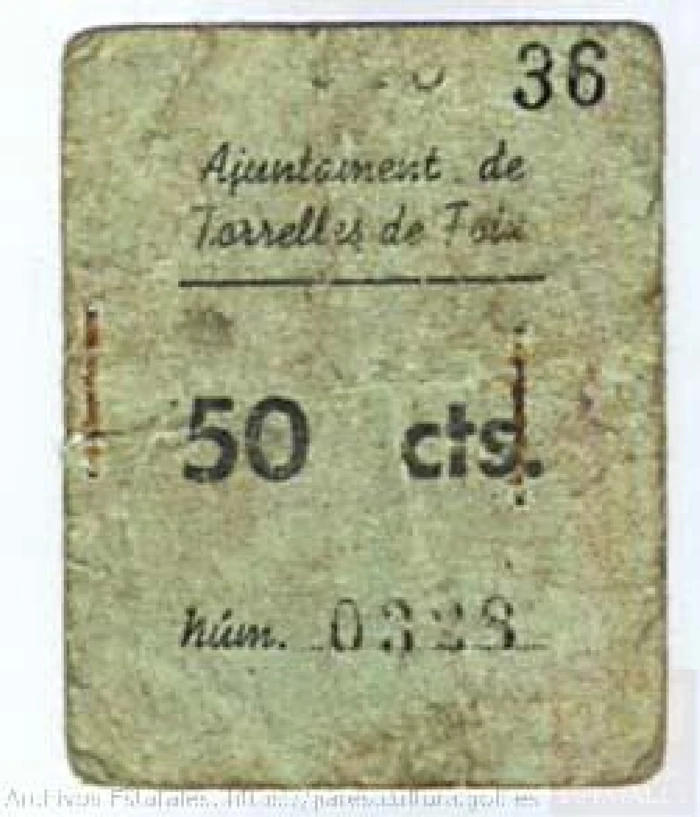
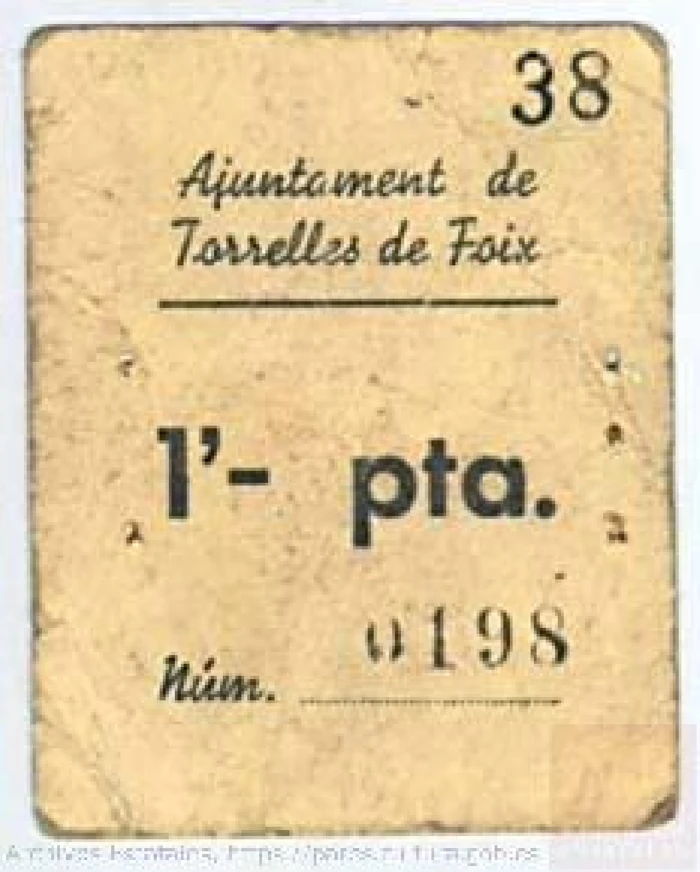
The simplicity of the material helps to understand the difference between the two issues, but does not allow us to know who decided on the design, how many vouchers were prepared, or what day they began to circulate. The numbers on the specimens are identifiers for individual pieces; on their own they do not amount to a count of the whole issue.
What can be stated is that these vouchers preceded the exchange agreed in September 1937. This is the documented date that fixes their circulation, without yet giving us the starting point.
03 · June 1937
The village portrayed on a banknoteThe village, drawn on a banknote
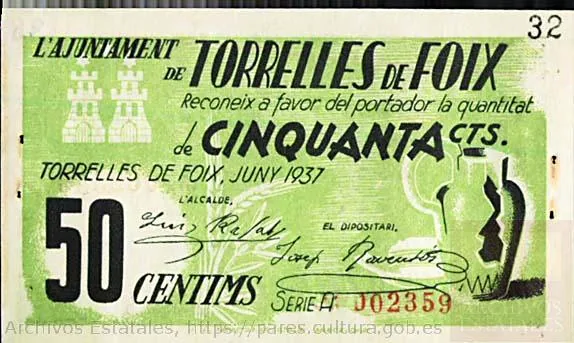
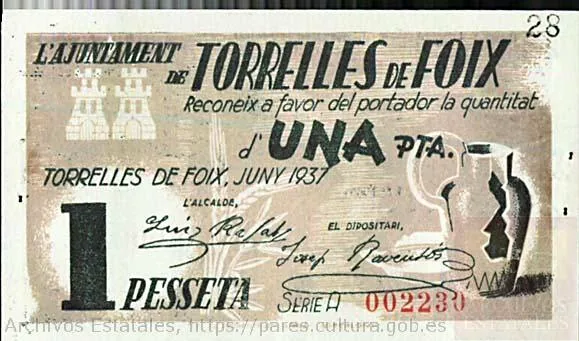
The printed banknotes bear the date June 1937. On the front is the village's coat of arms, a plate with a jug, and the signatures of the mayor, Lluís Ràfols Carbonell, and the treasurer, Josep Raventós Cercó. On the back is a fountain with many spouts that can be identified as les Dous: the village landscape turned into money.
According to the catalogue entry of the Pavelló de la República, the illustration is by Lluís Pallarès.
The printed banknotes of series A bear the date «June 1937». On the front, the Town Council acknowledges the value in favour of whoever presents the note. It features the local coat of arms, plant motifs and a plate with a jug. The signatures belong to the mayor, Lluís Ràfols Carbonell, and the treasurer, Josep Raventós Cercó.
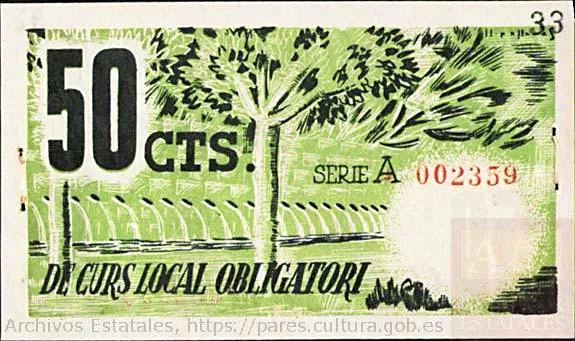
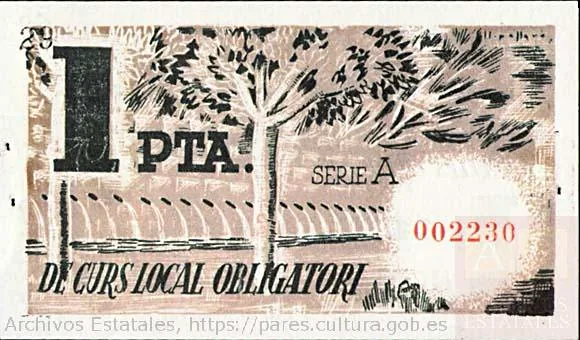
The reverse of both denominations shows a fountain with many spouts, identifiable as les Dous. It is a meaningful choice: the local landscape becomes the image on a payment document. The legend declaring it legal tender locally indicates the scope within which it was meant to be accepted.
The catalogue entry of the Pavelló de la República attributes the illustration to Lluís Pallarès and the printing to the Secretariat Català de Barcelona. It describes the fifty-centimo banknote in dark green on light green, 68 × 115 millimetres, and gives a print run of four thousand copies. This catalogue information complements the reading of the pieces held at the Archivo Histórico Nacional.
04 · 19 September 1937
Five thousand pesetas, seven thousand notesFive thousand pesetas, seven thousand banknotes
The agreement of 19 September 1937 provided for expanding the issue of banknotes to five thousand pesetas: three thousand of one peseta and four thousand of fifty centimos, seven thousand in total. It is not known how many actually came into circulation. As a guarantee, the amount was to be deposited in the municipal treasury as the notes were put into circulation.
The banknotes say June and the agreement is from September. Perhaps there was an earlier decision, or perhaps the issue was being expanded gradually: the papers read do not allow us to know.
The municipal agreement provided for expanding the issue to five thousand pesetas: three thousand in one-peseta notes and the remaining two thousand in fifty-centimo notes. The distinction between total value and number of banknotes is essential for reading the document correctly.
- One-peseta banknotes
- 3,0003,000 pesetas in value
- 50-centimo banknotes
- 4,0002,000 pesetas in value
The breakdown amounts to seven thousand notes for a value of five thousand pesetas. This is the volume set out in the agreement, not a verification of how many banknotes actually came into circulation. The figure of four thousand fifty-centimo notes matches the print run recorded in the catalogue of the Universitat de Barcelona.
The agreement also stipulated that, as the banknotes were put into circulation, their value should be deposited in the municipal treasury. The text documents the guarantee that was planned, but does not by itself confirm how this operation was carried out or what balance remained at the end.
There is also a question of timing: the banknotes are dated June, while the known agreement is from September. There could have been an earlier decision, or an issue that was expanded over time, but the documentation read does not allow one explanation to be chosen. The printed date should not automatically be taken as the first day of circulation.
05 · 1938–1941
From means of payment to archive pieceHow they have survived to today
On 2 August 1941, the Town Council sent information about that money, along with specimens of the vouchers and banknotes. The response is in the Causa General, the file compiled by the Francoist regime after the war. This is why the agreement and the pieces can be studied together today.
The municipal archive holds a 1938 report on the issues and the final settlement, and papers from 1939 on deliveries of paper money. They have not been consulted, and so it is not possible to explain precisely how this currency was withdrawn.
On 2 August 1941, the Town Council forwarded information about the issue and attached specimens of the vouchers and banknotes. This response forms part of the Causa General, the file compiled by the Francoist regime after the war. This is why the transcribed agreement and the pieces can be studied together today.
The provenance requires distinguishing the material facts about the currency from the political assessments in the file. The article is based on the denominations, the inscriptions and the financial agreement; the 1941 copy remains a later transmission of a 1937 document, still to be checked against the minute book.
The municipal inventory holds two leads to follow up: a report on the issues and final settlement, from 1938, and the delivery notes for paper money, from 1939, both in unit 462. The minute book covering 1937 is in unit 109. These files have not been consulted, and so it is not yet possible to explain precisely how the currency was withdrawn.
What remains to be known
Reading the specimens and the agreement makes it possible to reconstruct the intended system. To find out how it actually worked, progress will be needed on three points:
- Locate the first issuing agreement and clarify the relationship between June and September 1937.
- Consult the 1938 settlement and the 1939 deliveries to find out how many notes were withdrawn.
- Document other surviving specimens, with both sides, the number and the provenance.
What we still do not know
The pieces and the agreement explain how this currency was meant to work. To know how it actually worked, answers are still missing. For example:
- When the first issue was agreed, and why the banknotes bear the date of June if the known agreement is from September 1937.
- How many pieces were withdrawn. The 1938 settlement and the 1939 deliveries, in the municipal archive, might tell us.
- What other vouchers and notes survive, with both sides, the number and where they come from.
Documentary sources and bibliography
- 1937–1941 · Municipal agreement and coin specimens. AHN, FC-CAUSA_GENERAL, 1602, exp. 17, sheets 26–39.
- 1937 · 50-cent note. CRAI Biblioteca del Pavelló de la República, Paper moneda collection, item 183.
- 1938–1939 · Report on the settlement and deliveries. Municipal Archive, UI 462. Inventory reference. Files still to be consulted.
- 1923–1946 · Minute books of sessions. Municipal Archive, UI 109. Inventory reference.
This is the essential reading. The full research has 14 citations, 4 references and the documents to check it all.
Research by Amics de Foix, historical archive of Torrelles de Foix. The references make it possible to check the sources and follow the interpretations. Let us know of any correction or documentary contribution.