
Research
The Peguera, lords of Torrelles
The Peguera became linked to the lordship of Foix through a 15th-century marriage alliance and kept their ties to the area until 1881. Capbreus, lawsuits and parchments make it possible to study this domain and its relationship with the local community. Locating the family's patrimonial archive remains a central question of the research.
In the 15th century, a marriage made the Peguera the lords of Torrelles, and they remained so until the family died out, in 1881. This is their story, told through the papers that survive, with one question still open: where is the family's archive.
1067–1881 28 references 92 citations
Research index
1067 a 1388
The succession of the castle's lordshipsThe castle, changing hands
Foix castle already appears in a document from 984. Over the following centuries it passed from hand to hand, through purchases and wills. Being its lord meant holding the castle and rights over its area. From 1262 to 1381 it is recorded as belonging to the Cervelló family.
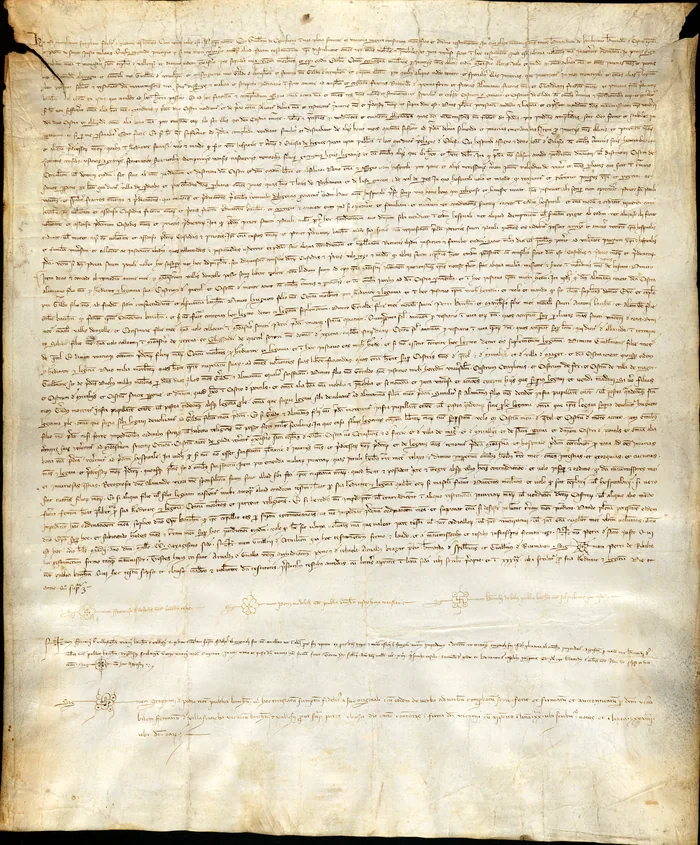
On 2 May 1388, King Joan I and Queen Violant sold the castle, the town and the area of Torrelles and Foix to Bernat de Pinós, a Barcelona jurist.
Foix castle appears for the first time in 984, as the boundary of an allod belonging to Sendred de Gurb, and in 1067 it appears again as the boundary of Pontons castle, in the sale that Bernat Oleguer makes to the Count of Barcelona.
In the 12th century it belongs to Bernat Marcús, a burgher of Barcelona and councillor to Ramon Berenguer IV, who died in 1166. In 1172 it belongs to Guillem de Bell-lloc, who also holds Font-rubí and Subirats. In 1198, Guillem de la Granada bequeaths it by will to Guillem de Tarragona, leaving money for the executors to build a church there.
On 5 August 1230, Guillem de Tarragona makes his will and, as lord of Foix castle, confirms to Santes Creus the quadres of Albareda, Dosrius, Mussarra and Daques. The castle does not pass to the monastery.
The information gathered describes transfers by purchase and by will. The continuity between the various holders of the lordship still needs to be clarified.
By 1262 Foix castle already belongs to the Cervelló family: the will of Guillem de Cervelló, dated 3 May, groups it together with Cervelló, Vilademàger, Miralles and Santa Perpètua. In 1269 the same Guillem bequeaths them to his son Guerau. They remain there until 1381, when a boundary ruling against the abbot of Santes Creus states that Guerau de Cervelló is its owner and that his brother Guillemonet holds and possesses it.
Only the published part of that 1381 ruling was known. The Pontons cartulary preserves the full record of execution, which states where the boundary line ran, marker by marker, and, in passing, that in August 1381 whoever held Foix castle was domiciled at the place of Torrelles. The same volume documents the area of Foix as a boundary marker as early as 1188. All of this is in the research La ratlla de ponent.
The chronology presents an open question: the Catalunya Romànica states that in 1370 the area passes to royal jurisdiction. On 18 July 1380, however, a Guillem de Cervelló issues a document dated at the Castell de Torrelles de Foix. One possible explanation is the distinction between royal jurisdiction and seigneurial domain; this interpretation requires documentary verification.
What is dated precisely is the sale. On 2 May 1388, King Joan I and Queen Violant sell the castle, the town and the area of Torrelles and Foix to Bernat de Pinós, doctor of law and citizen of Barcelona, with full civil and criminal jurisdiction.
The purchaser is a Barcelona jurist who acquires the lordship through a purchase. Ten years later, in 1398, that same Bernat de Pinós buys a censal with a pension of 2,000 sous from the universitat of Vilafranca for 44,000 sous.
1448
The intervention of Maria de CastellaThe village complains to the queen
In 1448, representatives of the area of Foix complained to Queen Maria de Castella, who governed Catalonia on behalf of her husband, Alfons el Magnànim, who was in Naples. The queen wrote to a nobleman: the letter speaks of oppression and violence against the people of the area, and orders him to appear before her.
Who this nobleman was is still not known. But it is the oldest document we have in which the village acts as one and complains about its lord.
Sixty years after the sale, representatives of the area lodge a complaint. The complaint reaches Maria de Castella, wife of Alfons el Magnànim and his lieutenant general in Catalonia while he was in Naples, and the queen writes to a nobleman.
The letter states that the complaint reached her nomine universitatis et hominum locorum et terminorum castri de Foxio, in the name of the universitat and of the men of the places and areas of Foix castle. It speaks of harm to the estate, of alienations and separations, and of oppressionibus, vexationibus et violentiis against the men. The queen orders him to appear before her in person. The letter is given at Perpignan, in December.
Of the recipient all that can be said is that it is not resolved: our reading of the parchment and the catalogue record give two different names, and the identification remains open until a verified palaeographic reading is available.
It is the oldest document we have in which the universitat of Torrelles acts as a body and complains about its lord. Two and a half centuries before the hunting lawsuit.
15th century
The marriage alliance and the arrival of the PegueraA marriage brings the Peguera
After Bernat de Pinós, the castle passed to his son Roger and, later, to Maria Agraïda de Cruïlles i de Vilafranca, lady of Foix. She married a Peguera from the Manresa line, and that is how the Peguera came to the Penedès.
The husband's name is not certain. The only contemporary document we have of the marriage is a parchment from 1484, where he appears as Gerard de Peguera. The succession of the previous eighty-six years is still not fully dated.
Bernat de Pinós gives the castle to his son Roger de Pinós. Afterwards, a collateral successor takes the title of lady of Foix and Torrelles: Agraïda de Vilafranca, married to Guerau Gilabert de Cruïlles, lord of Riudarenes. The daughter of this marriage, Maria Agraïda de Cruïlles i de Vilafranca, lady of Foix and of the quadra of Torrelles, marries a Peguera.
The name of that Peguera is not certain. The Gran Enciclopèdia Catalana gives it two ways, Guillem in the entry on the lineage and Guerau in the entry on the municipality, both times with the second surname de Montbui. The only primary source we have of the marriage is a parchment from 7 August 1484, where the couple sell censals to a merchant from Vilafranca for 19,106 sous and 4 diners and where he appears as Gerard de Peguera, knight, with his wife Grahida.
Where they came from is known: from a son of Bernat de Peguera i de Rajadell, of the Manresa line of the Peguera, which begins at Peguera castle in Fígols, in the Berguedà. The Peguera's connection with the Penedès is established through marriage.
The genealogical sequence still lacks a complete chronology. Between Bernat de Pinós's censal of 1398 and the Peguera parchment of 1484 there are eighty-six years during which the seigneurial succession is not fully dated. The 1448 royal letter documents the area's activity, but it does not yet make it possible to resolve the identification of the title-holders.
Chronology of the lordship
The succession, at a glance
The dates indicate the references located; they do not necessarily fix the start and end of each domain.
-
1067–1230
The first title-holders
The records identify various lords and transfers by purchase or will. The continuity between all the title-holders still needs to be clarified.
See the milestones and sources
1067 · Reference to the castle. Foix appears as the boundary of Pontons castle.
1172–1198 · Bell-lloc and la Granada. The bibliography places Guillem de Bell-lloc in 1172 and records the bequest of Guillem de la Granada to Guillem de Tarragona in 1198.
1230 · Will of Guillem de Tarragona. Confirms to Santes Creus the possessions of various quadres; Foix castle is not the subject of this bequest.
-
1262–1381
The Cervelló
Wills and judicial records document the Cervelló family's ties to Foix. The seigneurial domain must be distinguished from royal jurisdiction.
See the milestones and sources
1262 · Will of Guillem de Cervelló. Includes Foix castle among the goods mentioned.
1380–1381 · Presence and domain. A parchment is dated at Foix castle in 1380; the 1381 boundary ruling identifies Guerau de Cervelló as the owner.
Open question. The record of the transfer to royal jurisdiction in 1370 has to be verified against these later references.
-
1388–1398
Bernat de Pinós
The purchase of the castle, the town and the area places Bernat de Pinós, a Barcelona jurist, at the head of the lordship.
See the milestones and sources
2 May 1388 · The royal sale. Joan I and Violant sell the castle, the town and the area to Bernat de Pinós. The title deed is cited in a 1699 printed document.
31 October 1398 · Purchase of a censal. The document identifies Bernat de Pinós as a knight of Foix castle.
-
1398–1484Succession still to be dated
A succession still to be clarified
The bibliography places Roger de Pinós, Agraïda de Vilafranca and the Cruïlles before the Peguera. Dates are missing to reconstruct the passage from one house to the other.
See the milestones and sources
The family sequence. The marriage of Maria Agraïda de Cruïlles i de Vilafranca to a Peguera explains the transfer through marriage, but the date and the husband's name show discrepancies.
1448 · There is documentation on the area. The letter from Maria de Castella records a complaint from the community. The identification of the recipient remains open: the document does not resolve the succession.
-
1484–1881
The Peguera
The marriage is already recorded in an 1484 deed. Capbreus, parchments and lawsuits make it possible to study the family's relationship with the area up to the 1881 legacy.
See the milestones and sources
7 August 1484 · The marriage documented. A sale of censals mentions Gerard de Peguera and his wife Grahida, of Foix castle.
16th to 18th centuries · Seigneurial administration. Eleven capbreus preserve declarations of property, rights and dues.
1881 · The final legacy. Maria Manuela de Peguera i de Pedrolo dies without descendants and leaves her estate to the Visitation nuns of Barcelona.
Open each stage to see the milestones and the documentation that supports them.
Documentation becomes more abundant from 1484 onwards. The lack of dates for some title-holders does not imply an absence of activity, nor does it alone establish continuity of the domain.
Family tree
The Peguera family and its connections
The Torrelles branch and the families connected to it. Open the complete tree to see everyone documented, or filter for the main branch. Select a person to read their record.
1536 a 1629
The lordship set down in writingHouse by house and plot by plot
A capbreu is the document in which a lord's vassals declared before a notary what they held and what they paid, house by house and plot by plot. Since the parish books were destroyed in 1936, they are a key source for studying the village and its lands, even though they are not a complete census.
Eleven survive from the lordship of Foix and Torrelles, at the Arxiu Comarcal de l'Alt Penedès. The oldest is from 1536, and none is digitised.
A capbreu is the document in which the vassals of a lordship declare before a notary all the property they hold and the dues attached to it: house by house, plot by plot, with who it borders and what is paid. After the destruction of the parish books in 1936, capbreus are an essential source for studying settlement and property, even though they are not equivalent to a complete census.
Eleven survive from the lordship of Foix and Torrelles, all at the Arxiu Comarcal de l'Alt Penedès. The first is from 1536, by Lluís de Peguera, before notary Joan Llopis. The one from 1579-1580, by Guerau de Peguera, is titled Original capbreu de la vila de Torrelles y terme y castell de nostra senyora de Foix y terme de Sacabechs, made by notary Antoni Martí, with 170 folios on parchment. Then come those from 1625-1629, from 1700 (326 folios, with an index), from 1732-1735, from 1757-1758 and from 1770-1794.
The activity of the notary behind the first capbreu is also documented in other deeds. Six years earlier, on 14 September 1530, the same Joan Llopis recorded in Torrelles a settlement between two farmers, with the clause Actum est hoc in villa de Torrellis, termini castri de Fuxo. 35 volumes survive from that notary, from 1510 to 1553, in the same archive.
None of the eleven is digitised. Of the entire collection they belong to, which has 945 units, none is either. Consultation requires visiting the collection in person.
Other acts make it possible to follow the exercise of the seigneurial rights. In 1591 Lluís de Peguera ratifies the sale of a plot of land in Fontpregona made by Antoni Ferrer, of the mas de les Torres, and in 1620 Guerau de Peguera ratifies the sale of twenty jornals in the same place by the Ferrer brothers of Torres de Dalt. In March 1593 licence is granted to bless the bell of the chapel of Nostra Senyora del Roser at Torrelles castle, described there as "aleshores recentment obrada al pati"; on 26 May 1693 the visitor authorises the opening of a door to make a vestry there. And in 1603 the vicar general gives licence for mass to be said there at the request of don Lluís de Peguera.
The area also grows. Between 1203 and 1230 Santes Creus had gathered the quadres of Albareda, Dosrius, Daques and Mussarra, and in the first quarter of the 17th century it sells all four to the lord of Torrelles castle. Fort i Cogul gives the reasons: the lawsuits with that lord, how little they yielded and the money from the sale.
1623
The seigneurial ratification on the 1623 parchmentThe lord's signature
In 1623, in Torrelles, the Morgades family sold a plot of land. At the foot of the deed, in another hand and in Catalan amid the Latin, is the seigneurial ratification, the lord's signature: «Jo, Don Garau de Peguera...». According to a first reading, he signs in his own name and his mother's, and reserves his rights.
On the back there is an old number, 15: it means the parchment was once part of an ordered archive. Which one, we do not know.
On 29 November 1623, at the place of Torrelles, in the area of Santa Maria de Foix castle, Joan Morgades, farmer, and Àngela, his wife, together with Joan Morgades the son and Margarida, his wife, sell to Pere Morgades, farmer, for thirty pounds, a plot of land at the place called la Serra de Coll Beix, part of a larger plot of four jornals. The notary is Antoni Martí, of Vilafranca del Penedès. The document is a parchment now in private hands, which the association photographed on 11 September 2026.
At the foot of the deed, in a different hand and in Catalan amid all the Latin, is the seigneurial ratification:

I, Don Garau de Peguera, Lord of the district of Foix and the town of Torrellas, sign the aforesaid sale by right of lordship, both in my own name and by proxy of my lady and mother Doña Joana de Peguera; my right and that of my heirs being always saved in each and every respect.
The ratification is not an isolated case. In 1620 the same Guerau had already ratified a sale of the area with power of attorney from his mother, dona Joana, and in 1591 Lluís de Peguera had done the same, always at the foot of the same parchment and not through a separate act. The 1623 parchment is one more example of this.
The signature is not a formality. It states who he is, states on whose behalf he signs, and reserves his right with the formula that closes the line: lo dret a mi y als meus en tot y per tot sempre salvos.
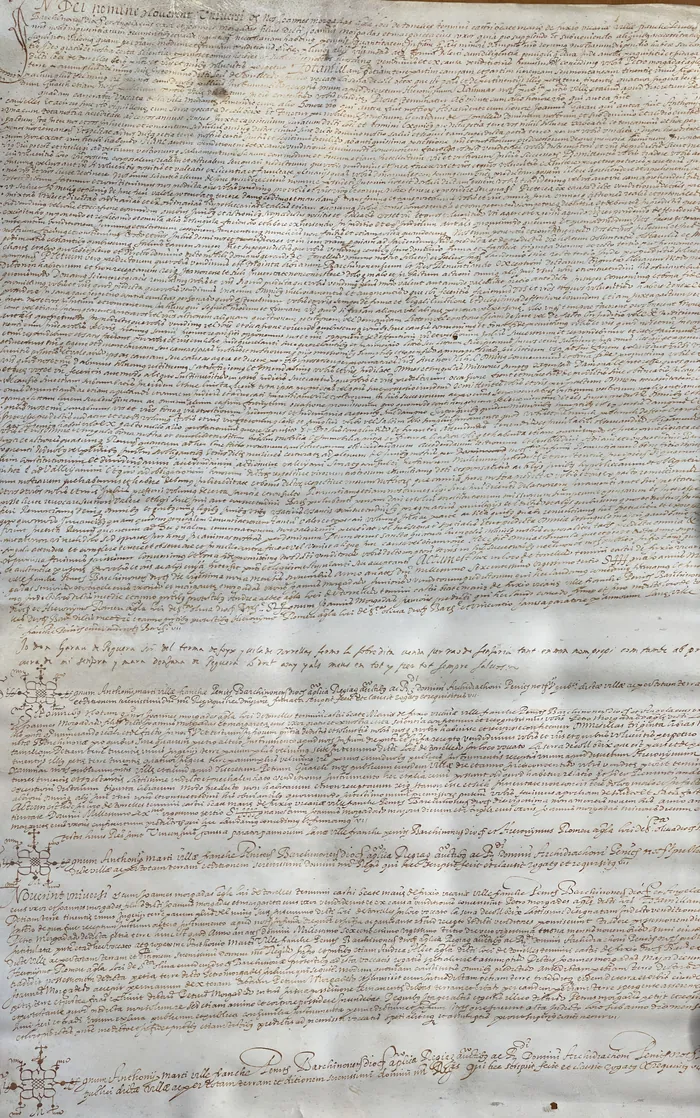
This is a first reading and has not been reviewed by any palaeographer.
There is one detail that matters for the whole investigation. On the back, in Catalan, it says una pessa de terra... en lo lloch de Torrelles de Foix, and there is an old archive numbering: No. 15. It means the parchment was once part of an ordered, numbered archive. Which one it was, we do not know.
The notary, at least, is known. Antoni Martí has 66 volumes of protocols, from 1575 to 1651, in the Vilafranca notarial district collection of the Arxiu Comarcal de l'Alt Penedès. The original of this sale must be there, along with the price, the buyer and all the other sales in the area from those years.
1669 a 1699
The village takes its lord to courtThe hunting and fishing lawsuit
The lord, Garau de Peguera, claimed that only he could hunt and fish in the municipal area, and that he could forbid it. Already in 1669 a court had ruled in favour of the Pegueras against the village, and in 1698 the village tried again: it wanted to be free to hunt and fish, except during the breeding season.
In 1699 the court ruled in favour of the lord, and the village appealed. Everything hinged on two Latin words in the 1388 deed of sale. How it ended, we do not know.
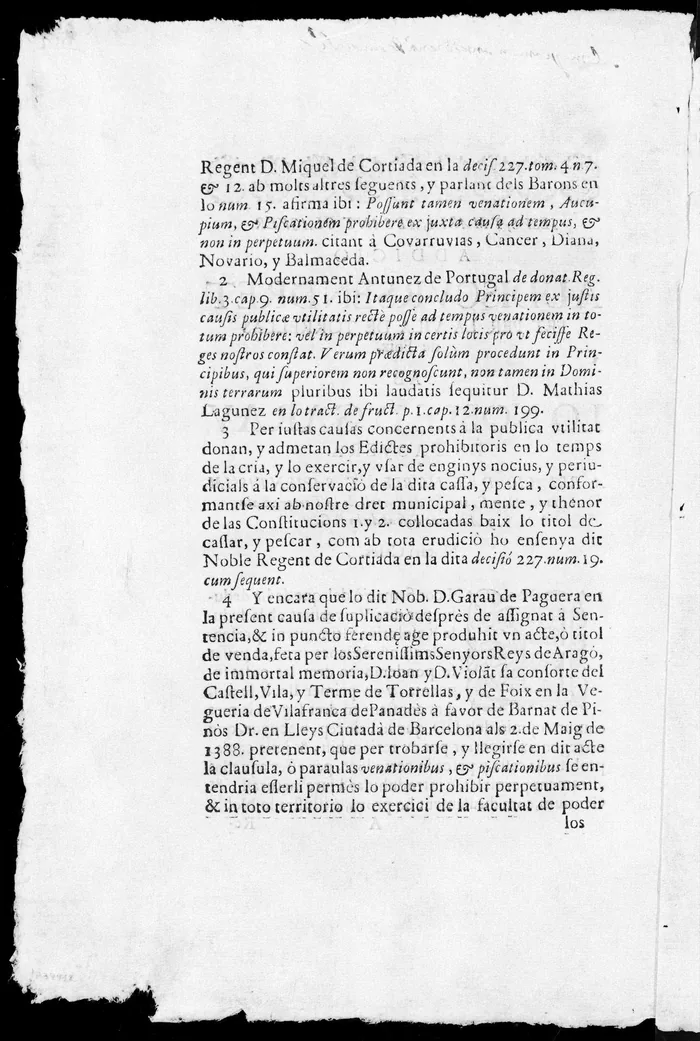
The conflict does not begin when we thought. On 14 June 1669, the Royal Audience had already issued a writ of maintenance in favour of Guerau de Peguera against the corporation of the town of Torrelles de Foix and Secabecs, later confirmed on appeal before senator Francesc de Portell.
Thirty years later, the village tries again. On 10 October 1698 the corporation brings the case. On 24 October, don Garau de Peguera argues that, as lord with full jurisdiction, he must be upheld in his right to issue proclamations banning hunting and fishing throughout the municipal area and along the stream, "from the pool of les Dous to the pool of Joan Font". On 9 December the corporation asks for the opposite: the freedom to hunt throughout the municipal area and fish throughout the stream, any kind of game or fish, except during the breeding season.
On 14 July 1699 senator Josep Moret ruled in favour of the baron, basing it on several proclamations published in the municipal area showing that the ban had existed for more than eighty years. On 28 July, the village's lawyers signed the printed allegation and appealed.
The whole lawsuit hinges on the interpretation of two words in the 1388 deed, venationibus et piscationibus. Peguera argued that they gave him the exclusive right to hunt and fish throughout the municipal area forever; the village, that regalian rights are not ceded unless expressly stated. And in paragraph 27 of its reply, the village demolishes the other side's figure: of all the distraints Peguera claimed to have made, only two were proven.
In 1744, forty-five years later, Barcelona lawyers were still citing the Torrelles case as established doctrine on whether a lord may forbid hunting and fishing to his vassals. The Torrelles case therefore had an impact on legal doctrine.
The outcome of the appeal remains unknown: the printed document consulted is a one-sided allegation and does not contain the ruling.
1711
The Marquisate of Foix and the War of the Spanish SuccessionMarquises of Foix, in the midst of war
In the War of the Spanish Succession, the Pegueras sided with Archduke Charles of Austria, and on 3 January 1711 the archduke made Guerau de Peguera i de Berardo Marquis of Foix. Of his sons, Antoni defended Barcelona in 1706, Lluís died fighting, and Josep Francesc defended Barcelona in 1714 and was wounded.
Philip V did not recognise the title: Guerau's property was confiscated and his title burnt. Half a century later, in a lawsuit of 1764 and a will of 1767, his descendants call themselves Barons of Rocafort, not Marquises of Foix.
From 1563 to 1713 the Pegueras attend the Corts of the Principality as señores de Torrelles y de Foix. Guerau de Peguera i de Ferrer appears at the Corts of Montsó in 1563, his son in 1599, and that son's son in 1626, the latter as protector of the Military Estate. At the same 1626 Corts is his brother, Lluís de Peguera i de Llaudes, a Knight of Santiago and camp master.
On 3 January 1711, Guerau de Peguera i de Berardo, lord of Torrelles and Foix, obtains the title of Marquis of Foix from Archduke Charles III of Austria. The grant reflects the family's ties to the Habsburg cause.
His son Antoni de Peguera i d'Aimeric (1682-1707) was a founding member of the Acadèmia dels Desconfiats in 1700, conspired in 1704, fled to Vienna, negotiated and signed the Pact of Genoa in 1705, was the first colonel of the Guàrdies Catalanes regiment, and defended Barcelona during the 1706 siege. He died in Valencia in 1707. Another son, Lluís de Peguera i d'Aimeric, was a page to the archduke king, who granted him the county of Peguera in 1708, and died fighting. The place of his death is uncertain: some sources say Gurb, in Osona, others Gurp de la Conca, in the Pallars Jussà. He is buried at Santa Maria de Foix. In 1767 his nephew Ramon still calls him «Count of Peguera», and endows an anniversary mass for him, every 2 May, in the chapel of the castle of Torrelles.
The third, Josep Francesc de Peguera i d'Aimeric, second Marquis of Foix and Baron of Montnegre, defended Barcelona in 1714 and was wounded. He made his will on 17 September 1746.
Philip V did not recognise the archduke's titles. Guerau's estate was confiscated and his title was burned. According to Albert Parellada, arrested in 1715, he died a prisoner in Pamplona, and his grandson Ramon had his remains moved to Foix. After that we have found no document in which the family calls itself marquises of Foix. In the 1764 lawsuit over the barony of Rocafort, their attorney calls Ramon and Gertrudis de Peguera «Barones de Rocafort». And in his will of 1767, Ramon calls himself «Baron of Rocafort and Lord of Torrelles de Foix».
There were three candidate dates for the title on the table: 1706, 1710 and 1711. Three of the four sources trace back to the same place, Armand de Fluvià, and the date he gives with the document in hand is 3 January 1711. This date is adopted on the strength of the documentary reference identified, while recording the bibliographical variants.
1726
The conflict over burial rightsWho could be buried in the church
In 1722, the parish priest Diego Hortiz wanted a tomb for himself inside the church of Santa Maria de Foix. The Pegueras opposed it. In Barcelona the priest was upheld, but in 1726 a court in Tarragona ruled in favour of the Pegueras: only members of their family could be buried there, and the priest had to remove the coloured tiles from his tomb.
The lawsuit copies burial records from 1608 to 1659, from parish books that were burned in 1936.
The Peguera burial was collective. The Mapa de Patrimoni places Antoni Maria's remains there, with a manuscript giving his name and age; we still do not know where that document is. The sarcophagus front with deer is a separate piece, belonging to the Cervelló family.
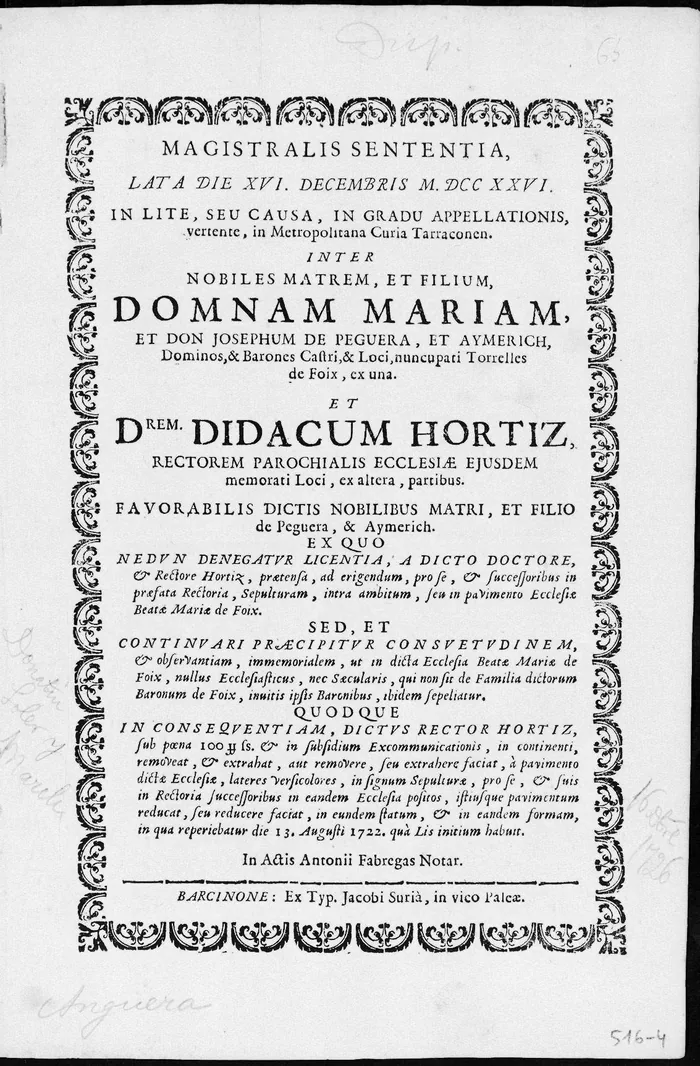
On 3 August 1722, the parish priest Diego Hortiz wanted to secure a burial place for himself and his successors inside the church of Santa Maria de Foix. The Pegueras opposed it. The bishop's ordinary court of Barcelona upheld the priest on 3 October 1722, and on 16 December 1726 the Metropolitan Curia of Tarragona overturned it on appeal.
The parties are doña Maria and don Josep de Peguera i Aymerich, mother and son, Dominos et Barones Castri et Loci nuncupati Torrelles de Foix. The appeal is resolved in their favour. The ruling orders that in the church of Santa Maria de Foix no cleric or layperson who is not of the family of the barons of Foix may be buried there, and orders the priest to pull up the coloured tiles marking his tomb from the floor and leave it as it was on 3 August 1722.
The same lawsuit describes the lords' tomb: a large sepulchre in the floor, with the family's coat of arms and a crypt dug out beneath. Forty years later it was still in use: in 1767 Ramon de Peguera, son of Josep, asks in his will to be buried at Santa Maria de Foix, «in the vault of my parents and forebears».
The Mapa de Patrimoni Cultural places the remains of Antoni Maria de Peguera i de Pedrolo, who died aged eighteen, in a collective tomb at the foot of the main altar, with a manuscript recording his name and age. The slab bearing the Peguera coat of arms, found and repositioned in 1985, marks an ossuary in front of the presbytery. It must be distinguished from the medieval sarcophagus front belonging to the Cervelló family, decorated with deer. The current location of Antoni Maria's manuscript remains unknown.
The value of the printed document also lies in the documents it incorporates. The parties submitted testimony drawn from the parish archive. That archive burned in 1936. Inside are burial records from 1608 to 1659 with the names of villagers, taken from books that no longer exist. They have not yet been transcribed.
Those are also the years when work is carried out on the castle house. In 1720 and 1723, Maria d'Aimeric, by then a widow of the first marquis, who died a prisoner in Pamplona, requests a building licence from the Reial Patrimoni.
1742 a 1848
Estate, income and family debtDebts, lawsuits and hens
In 1742, Ramon de Peguera and Gertrudis d'Armengol married. They were second cousins: their grandmothers, Maria and Gertrudis d'Aymerich, were sisters. Bernat's (1702) and Anna's (1724) wills identify both couples and confirm that the women were sisters; the degree of kinship is deduced from this. The original notarial registers have not yet been checked directly. After a dispute, the title of Rocafort passed to the Peguera family. That is why the area's muntanya del Baró is called that.
Ramon died in Barcelona on 15 July 1767. In his will he asked to be buried at Santa Maria de Foix, with his parents, and for his son to build a shrine chamber there for the Virgin.
Debts and more lawsuits followed. To justify why the income was worth little, the family claimed that the hens the municipal area paid them with were of poor quality. And in 1827 they spent 400 pounds fixing up the family archive: so it existed then.
In 1742, Ramon de Peguera i de Berart marries Gertrudis d'Armengol i de Despujol, daughter of the Baron of Rocafort de Queralt. They were second cousins: their grandmothers, Maria d'Aymerich and Gertrudis d'Aymerich, were sisters. Bernat d'Aymerich's 1702 will names his daughters Maria and Gertrudis together with their husbands, Grau de Paguera and Antoni d'Armengol. Anna d'Aymerich's 1724 will explicitly says that Maria de Paguera and Gertrudis d'Armengol were «germanas mias». The Castelló lawsuit confirms the three sisters and their parentage; the link to Paguera is already explicit in the 1702 will. The spouses who married in 1742 descended from these sisters:
- Maria d'Aymerich + Grau/Guerau de Paguera → Josep Francesc de Peguera i d'Aimeric (1684) → Ramon de Peguera.
- Gertrudis d'Aymerich + Antoni d'Armengol i d'Agulló → Antoni d'Armengol i d'Aimeric (1692–1764) → Gertrudis d'Armengol (1724–1805).
Their fathers, Josep Francesc and Antoni, were first cousins; their children, Ramon and Gertrudis, were second cousins. This relationship is deduced from the parentage in the wills, not from a sentence calling the spouses “cousins”. The Barcelona dispensations index records a 28 January 1679 file for Grau de Paguera and Maria d'Aymerich in Barcelona, but does not give the wedding date; Antoni and Gertrudis's marriage contracts date from 20 April 1689. The published genealogical evidence consists of Lladonosa's transcriptions (2021); the two original notarial registers have not yet been checked directly.
The title of Rocafort did not pass to the Peguera family in 1742: Gertrudis's father remained baron until his death in 1764, after which her uncle, Manuel d'Armengol, disputed the succession. The lawsuit ran from 1764 to 1766, and the lordship eventually passed to Gertrudis and, through her, to the Peguera family. The barony is not from the municipal area, it comes from the Conca de Barberà, but it is the title under which the lords of Torrelles are named throughout the 19th century, and that is why the Muntanya del Baró in the municipal area has that name.
In 1764, the councillors and the corporation of Torrelles take Ramon de Peguera to court over jurisdiction of the municipal area. The lawsuit fills a whole volume, in Spanish, Latin and Catalan. It is the piece that should explain what the village was claiming, and it has not yet been read.
Ramon makes his will in Barcelona on 21 June 1767, ill in bed, and dies on 15 July, in the family's houses on the Rambla and Carrer de la Canuda. The will lays down harsh conditions: it disinherited any descendant who became a cleric or did not keep the surname and coat of arms. He leaves three thousand masses, fifty of them in the church of Torrelles, and charges his heir with building a shrine chamber in the church of Foix, if he himself has not been able to. His widow Gertrudis administers the estate and conducts capbreu surveys in the municipal area between 1770 and 1794.
During the generation of Ramon-Lluís de Peguera i d'Armengol, the records show a process of family debt. On 3 November 1779 he takes out a censal loan of 3,000 pounds from the Amat family, his wife's family, and another thousand five days later. With the Peninsular War they could not pay the annuities, the Amats took them to court, and the lawsuit lasted twenty-two years, from 1826 to 1848. Ramon-Lluís made his will on 4 November 1813 and was declared incompetent in 1819.
The surviving accounts give an approximate picture of the estate's finances. Around 1827 it had an income of 10,724 pounds and liabilities of 7,494: leaving 3,230. That year 1,953 pounds were spent on censals, 522 on life annuities, 3,000 on rebuilding derelict buildings, 2,000 on lawsuits and 400 pounds on restoring the family archive.
The 400-pound expense is a significant reference point for the archive's history. In 1827 the Pegueras' archive existed and money was being spent on it. Locating this collection could yield documentation spanning several centuries on the municipal area of Foix.
When they had to justify why the income was worth so little, the Pegueras claimed the poor quality of the hens paid to them as rent, which they said could only fetch four pesetas each. In the 19th century the municipal area was still paying its lord with hens.
The village castle was torn down around 1835. Of the Pegueras' manor house only a wall remains, along with a few scattered remains in the basement.
1874 a 1881
Maria Manuela's legacy and the scattering of the archiveThe last Peguera and her legacy
In 1881, Maria Manuela de Peguera i de Pedrolo, the last of the family, died unmarried and without children. According to Albert Parellada, an 1874 will left the village the Roser chapel and the land known as els Navegants. The rest went to the Visitation nuns of Barcelona. Some texts say «Salesians», but that is a different order.
Where the family's papers ended up is still not known. A letter has been sent to the Visitation nuns and to the Arxiu Diocesà de Barcelona, who have not yet replied.
In 1874 there is a will under which the estate in the municipal area, the Roser chapel and the land known as the Navegants, passes to the village. In 1881 Maria Manuela de Peguera i de Pedrolo (1821-1881), Baroness of Rocafort de Queralt, dies unmarried and without issue. The lineage dies out, and everything that remains goes to the Visitation nuns of Barcelona.
Josep Castellanos already explained this in 1893, on returning from a stay in the village: the family died out with the last baroness, "who founded the Visitation convent, to which she left all her estate", and that "she was buried in the church-sanctuary of Foix". This account agrees with other bibliographical references cited in this research.
Identifying the beneficiary community
The Visitation nuns are the nuns of the Order of the Visitation of Holy Mary, founded in 1610 by St Francis de Sales and Jane Frances de Chantal. The Salesians are the Daughters of Mary Help of Christians, of the Don Bosco family. They are two different orders, and everything indicates that the legacy went to the former.
The discrepancy can be traced through the text's transmission. The Gran Enciclopèdia Catalana shows it itself: in the entry on the Peguera lineage it says "the Visitation nuns of Barcelona", and in the entry on the municipality, for the same death and the same year, it says "Salesians".
From that entry came, in 1991, a framed calligraphic plate kept by the association, signed "J. Vilalta 91". It follows the encyclopaedia's text almost word for word, including "old maid", and it carries over the "Salesians" error. From the plate it passed to the Town Council's website, which has widened its circulation.
The distinction between the two communities is relevant for guiding the search for the family archive. The same plate says the castle is "documented in the 1.607", a possible misreading of 1067 that needs to be checked against the reference text.
The legacy and avenues for archival research
No document we have says which house of the Visitation nuns received the legacy. The connection with the Visitation convent on the Passeig de Sant Joan is a hypothesis yet to be checked.
The research has not been able to establish the location or extent of the community's archive. There is no collection record either in Arxius en Línia or in PARES, but this absence does not allow us to conclude that the collection is not preserved. On 24 September 2026 a letter was sent to the community and to the Arxiu Diocesà de Barcelona to find out whether they hold documentation on the legacy; they have not yet replied.
To study the scope of the legacy, four sets of documents would need to be located: Maria Manuela's will, which must be in a notarial protocol in Barcelona; the title deeds of the estates in the municipal area, the only way to know exactly what els Navegants, les Planes de Foix, l'Albareda and el Clapí Peralta were before 1890; the Pegueras' family archive, the one behind the 400 pounds spent in 1827; and the community's accounts for the years of the legacy, to see the Torrelles estate entering them.
Today
Open research questions
This research has been able to date and attribute a good part of eight hundred years of lordship. What it has not been able to do is answer the question that started it.
- Where is the Pegueras' family archive. In 1827 it existed and 400 pounds were being spent on it. In 1881 the estate passed to the Visitation nuns. On 24 September 2026 a letter was sent to the community and to the Arxiu Diocesà de Barcelona; they have not yet replied.
- Maria Manuela de Peguera i de Pedrolo's will, which must be in a notarial protocol in Barcelona. Parellada dates it to 1874.
- The name of the recipient of the 1448 royal letter, which requires palaeography and a better image.
- The four digitised parchments available, from 1332, 1380, 1398 and 1484, untranscribed. The 1484 one is a priority because it documents the presence of the Peguera couple in the municipal area.
- The original deed of the 1623 sale, among Antoni Martí's 66 volumes at the Arxiu Comarcal de l'Alt Penedès. With it, the price and the buyer's name.
- The ruling on the 1699 appeal, and the writ of maintenance of 14 June 1669 in the registers of the Royal Audience.
- The burial records from 1608 to 1659 that the burial-rights lawsuit copies, from parish books that burned in 1936.
- Documentation of the work in the Peguera tomb: the plan and excavation records should make it possible to relate the structures, remains and layers. The current location of Antoni Maria's manuscript is still to be established.
- The 15th-century arbitration ruling on the castle and municipal area of Foix, at the Arxiu Comarcal de la Segarra,
ACSG220-52-T2-446. A simple documentary unit, with no further description. - The exact date of the sale of the four quadras of Santes Creus land to the lord of Torrelles, and before which notary it took place.
- Gurb or Gurp: where Lluís de Peguera i d'Aimeric died, and whether 2 May, the day of his anniversary mass, is the day he died.
- The shrine chamber Ramon de Peguera commissioned in 1767: whether his son built it, and where Ramon was buried.
Archives and collections to consult
The following references guide consultation of the archives and the religious community linked to the research.
- Arxiu Comarcal de l'Alt PenedèsOne of the main sets of documents on the lordship.
ACAP20-2041, "Capbreus solts", series "Senyoria de Foix i de Torrelles - Peguera", eleven units from 1536 to 1820, none digitised.ACAP20-17, Comunitat de Preveres, with the parchments from 1332, 1398 and 1484.ACAP20-2062, the nine parchments of the Torrelles Town Council.ACAP20-25, notarial district, with Antoni Martí's 66 volumes. - Arxiu Nacional de Catalunya
ANC1-59-T-351, the grant of the Marquisate of Foix, 3 January 1711.ANC1-167-T-7598, the village's lawsuit against Ramon de Peguera, 1764.ANC1-1087-T-4749, the parchment dated at the castle of Torrelles in 1380.ANC1-989-T-405, Lluís de Peguera at Torrelles, 1534. - Arxiu de la Corona d'AragóCartes Reials, Alfons IV [V], no. 1848, the 1448 letter. Reial Audiència, Plets civils
1632and5355. Reial Patrimoni, BGRP, Processos,1720 no. 3 Bfand1723 no. 8 An, the works on the castle house. Cancelleria, register 1784, folios 182v-185, the 1381 ruling on the boundary markers. - Arxiu Municipal de Castelló d'Empúries
AMCE560-81, Família Negre Pastell collection, which holds the archive of the Armengols, barons of Rocafort. Published in the catalogue in November 2025: newly catalogued material. - Arxiu Comarcal de la Segarra
ACSG220-52-T2-446, Cort del Veguer i del Batlle de Cervera, 15th century: "Sentència arbitral sobre el castell i terme de Foix". - Biblioteca de CatalunyaThe printed allegation of 1699, copy no. 4573, and the parchment of Guillem de Cervelló's 1262 will, pergamí 524.
- Arxiu Diocesà de BarcelonaIn case the Visitation nuns' archive is deposited there. A letter was sent on 24 September 2026; they have not yet replied.
- Monestir de la Visitació, Can MarcetBarcelona, where the Visitation community is today. A letter was sent on 24 September 2026 to find out whether it holds documentation on the 1881 legacy; it has not yet replied.
What we still do not know
The research has dated and located a good part of eight hundred years of lordship, but the question that started it still has no answer. And it is not the only one:
- Where the Peguera family archive is. In 1827 it existed, and in 1881 the estate passed to the Visitation nuns.
- How the hunting and fishing lawsuit ended. The ruling on the 1699 appeal has not been found.
- Whether the lords' sepulchre and its crypt are still beneath the sanctuary's floor.
- Where Lluís de Peguera i d'Aimeric died: at Gurb, in Osona, or at Gurp de la Conca, in the Pallars Jussà.
Documentary sources and bibliography
- Gran Enciclopèdia Catalana, entries on Torrelles de Foix, Peguera (lineage), Guerau de Peguera i de Berardo and Antoni de Peguera i d'Aimeric
- Catalunya Romànica, entry on Santa Maria de Foix
- Pere Català i Roca (dir.), Els castells catalans, volume III, Rafael Dalmau editor, Barcelona, 1971
- Eufemià Fort i Cogul, El senyoriu de Santes Creus, Fundació Salvador Vives Casajuana, Barcelona, 1972
- Josep M. Casas Homs, "Qüestió de límits entre l'abat de Santes Creus i el senyor de Foix", Santes Creus 28 (1968), pages 431-439
- A. Selva, "L'enterrament dels Tarragona", Santes Creus 13 (1961), pages 111-113
- Francisco José Morales Roca, Próceres habilitados en las Cortes del Principado de Cataluña, siglo XVII (1599-1713), Ediciones Hidalguía, Madrid, 1983
- Salvador-J. Rovira i Gómez, "Notes d'arxiu sobre els Armengol, barons de Rocafort de Queralt", Aplec de Treballs 24 (2006), pages 109-116
- Manuel Güell i Junkert, Els Peguera i la baronia de Rocafort a principis del segle XIX
- Albert Parellada, Els Peguera i el 1714, Del Penedès 30 (2014)
- Ainhoa Pancorbo Picó, Mapa de Patrimoni Cultural de Torrelles de Foix, Diputació de Barcelona, record 08288-68, archaeological site of Santa Maria de Foix
- Mapa de Patrimoni Cultural, record 08288-87, stone slab bearing the Peguera coat of arms
- Mapa de Patrimoni Cultural, record 08288-86, sarcophagus front from Santa Maria de Foix
- Vicent Lladonosa Giró, Documents de la família Aymerich-Cruïlles, Ajuntament de Rajadell, 2021; transcriptions of the wills of Bernat d'Aymerich (1702, printed pages 53–60) and Anna d'Aymerich (1724, printed page 62). For the 1702 will, the edition gives AHPB, Josep Brossa, volume 824/84; original registers not consulted directly
- Josep Castellanos, Butlletí del Centre Excursionista de Catalunya, 1893
- Allegacio en dret a favor de la universitat de la vila de Torrellas de Foix y Secabechs, Barcelona, 1699. Biblioteca de Catalunya, no. 4573
- Addicio al discurs en dret, 1699. Memòria Digital de Catalunya, allegacions 120006
- Ruling of the Cúria Metropolitana de Tarragona, 16 December 1726. Memòria Digital de Catalunya, allegacions 126088
- 1744 allegation from the lawsuit of the lords of Llinars. Memòria Digital de Catalunya, allegacions 102342
- Will of Guillem de Cervelló, 1262. Biblioteca de Catalunya, pergamí 524
- Definició atorgada a Torrelles de Foix el 14 de setembre de 1530. Biblioteca de Catalunya, Memòria Digital de Catalunya, pergamiBC 78540
- Arxiu de la Corona d'Aragó, Reial Cancelleria, Cartes Reials, Alfons IV [V], no. 1848
- Arxiu de la Corona d'Aragó, Reial Audiència, Plets civils 1632
- Arxiu Comarcal de l'Alt Penedès, collections ACAP20-2041, ACAP20-17, ACAP20-2062 and ACAP20-25
- Arxiu Nacional de Catalunya, Armand de Fluvià, Sentmenat, Desvalls and Rocabruna collections
- Ajuntament de Sant Celoni, La Batllòria cap a l'any 1500 (3). El casal dels Gualba
- Parchment of the sale of 29 November 1623, in private hands. Photographed by Amics de Foix on 11 and 25 September 2026
- Arxiu Comarcal d'Osona, Hospital de la Santa Creu de Vic collection, ACOS80-23-T2-1243 (documents 5, 6 and 7), ACOS80-23-T2-1245 (documents 1 and 4) and ACOS80-23-T2-2006 (the will of Ramon de Peguera of 1767). Digitised by the archive in September 2026
This is the essential reading. The full research has 92 citations, 28 references and the documents needed to check everything.
Research by Amics de Foix, historical archive of Torrelles de Foix. The references make it possible to check the sources and follow the interpretations. Let us know of any correction or documentary contribution.