
Research
The western boundary
The Pontons cartulary, held at the Archivo Histórico Nacional, mentions the boundary of Foix as the limit of a farmhouse in 1188 and records a boundary-marking with twelve stones in 1381. Between these two dates, the documents allow the Foix, castellans of Pontons, to be traced, along with the rights they transferred to Santes Creus. The medieval line has to be reconstructed from place names and markers; today's municipal boundary is only a rough guide.
A book from the monastery of Santes Creus, now in Madrid, copies the Pontons papers, the neighbouring municipal area. It records the boundary between the two areas, from 1188 to the twelve boundary stones of 1381, and a family that shared its name with the castle of Foix.
1188–1381 3 references 24 citations
Research index
L.839
A cartulary from the neighbouring village, in MadridA book from the neighbouring village, kept in Madrid
In the 18th century, an archivist monk copied the parchments of the monastery of Santes Creus into several volumes. It is the Llibre Blanch. The first volume is that of Pontons, the neighbouring area, and today it is held at the Archivo Histórico Nacional, in Madrid. It contains documents from 1080 to 1543.
The rights of lords and peasants cut across the boundaries of municipal areas. That is why these papers also speak of Foix, with information that has not been found in the municipality's own archives.
The "Llibre Blanch" of Santes Creus is the copy an 18th-century archivist monk made of the monastery's parchments, arranged by lordship. The first volume is that of Pontons, and it is held at the Archivo Histórico Nacional in Madrid, under the shelfmark CÓDICES, L.839.
The thread of the investigation
- 1188A boundary mentioned
A farmhouse in Pontons borders the area of Foix to the east.
- 1227–1293The castellans' rights
The Foix acquire rights over the castle of Pontons and later transfer them to Santes Creus.
- 1381A boundary marked out
Ruling of 5 July and the placing of twelve boundary stones from 8 to 10 August.
There are 237 images, with the body of the book numbered 1 to 389 and, at the end, an index of 226 entries written in Catalan, giving a summary of each document and a column showing the page it is copied on. There are documents from 1080 to 1543, most of them from the 12th and 13th centuries.
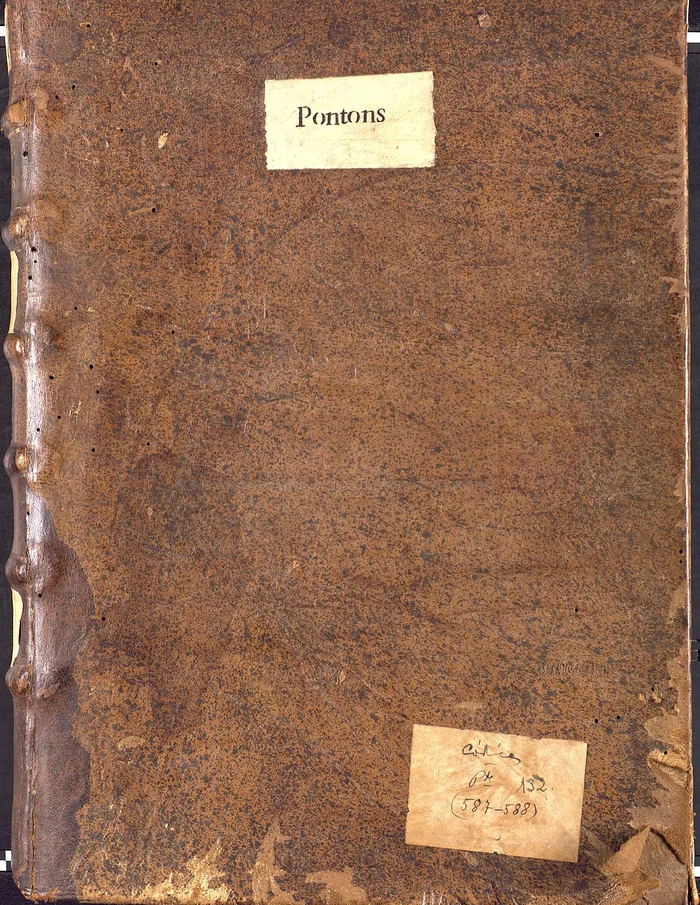
It is the neighbouring area, not ours. The rights of lords, castellans and peasants cut across the boundaries of the area. That is why the Pontons records also provide information about Foix that has not been found in the municipality's own archives.
The cover keeps traces of the volume's history: a label reading "Pontons" and another with the old shelfmark of the Biblioteca Provincial de Tarragona, "Cist.ces / Pº 132 / (587-588)". There is no preface, no date and no archivist's name.
1188
“In termino de Fodex”A farmhouse that bordered the area of Foix
On 24 January 1188, Ramon d'Òdena and his wife Berenguera give a farmhouse in the Pontons area to Bernat de Foix and his wife Guillelma. The document gives its boundaries, and to the east it names the area of Foix. It also allows Bernat de Foix to build a fortified house there.
For now, it is the earliest mention of the boundary line found in a document. The Catalunya Romànica, however, already places Foix as the limit of the castle of Pontons in 1067.
On 24 January 1188, Ramon d'Òdena and his wife Berenguera give Bernat de Foix and his wife Guillelma a farmhouse in the Pontons area, the one that had belonged to Ramon Dalmau. And they give its four boundary descriptions:
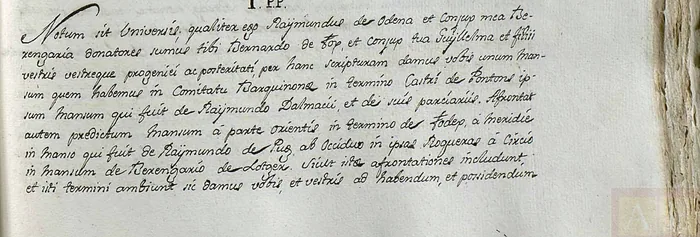
To the east, the area of Foix. To the south, the farmhouse that had belonged to Ramon de Puig. To the west, les Roqueres. To the north, the farmhouse of Berenguer de Lotger.
It is, for now, the earliest mention of the boundary between Pontons and our area that we have read in a document; the Catalunya Romànica already places Foix as the limit of the castle of Pontons in 1067. A hundred and ninety-three years later, a deed describes the boundary-marking between the two areas. We cannot be sure, from just these two texts, that the whole line was identical.
The document continues on the next page and adds something not to be overlooked: the Òdena authorise Bernat de Foix to build a força there, the medieval name for a fortified house, on condition that they may enter and leave it and wage war from it, and that no other lord be acknowledged there. The price of the whole is fifty sous.
Also mentioned, in that part of the area, are a parellada at Bosc d'Olla, Puig de Cúnies and Coma de Prunes.
1188 a 1295
Those who shared the castle's nameA family that shared the castle's name
In the Pontons papers a family appears with the same name as the castle of Foix, written Fodex, Foy, Foyg or Fuxio. But that does not mean they were its lords. They were castellans of Pontons, meaning they held that castle on behalf of a higher lord. What relationship they had with the castle of Foix has not yet been established.
The documents also show the women of the family, such as Blanca, who in 1271, already widowed, managed her children's estate.
The name appears in the volume in four forms: Fodex in documents from 1188 to 1236, Foy in the signatures of 1226, Foyg (written foijg) in both Latin and Catalan, and Fuxio in the Latin of the second half of the 13th century and of 1381. It is the same name as the castle's, not the modern form "Foix".
Bearing the castle's name does not mean they were its lords. In the 13th century the castle of Foix belonged to the Tarragona family and later to the Cervelló family. These Foix were castellans of Pontons, and the relationship between the two is still unresolved.
The documents show several ways of gaining access to the Pontons estate: inheritance and the acquisition of rights. In 1224, when he sells the els Clots farmhouses, Guillem de Foix states where they came from: from the bequest of his uncle Arbert de Pontons. The kinship expressed by the Latin word avunculus points to the maternal line; on its own, it does not settle the whole genealogy.
Three years later, on 13 November 1227, Bernat de Pontons confirms the purchase that Guillem and his wife Ermessenda had made from B. de Sarovira. The document mentions three hundred sous and reserves the right of the higher lord, the senioraticum.
- 1188
Bernat de Foix and Guillelma
They receive from Ramon d'Òdena a farmhouse in the Pontons area bordering the area of Foix to the east, along with a licence to fortify it.
- 1224
Guillem de Foix and Ermessenda
They sell the els Clots farmhouses, which had come to them through the bequest of uncle Arbert de Pontons.
- 1227
The purchase of the castle
Guillem de Foix and Ermessenda buy the castellanship of Pontons from B. de Sarovira, and Bernat de Pontons approves the sale.
- 1269
Guillem de Foix the Younger
He makes his will before Jaume I's crusade and leaves ten sous to Santa Maria de Foix. The will expresses his intention to travel; it does not prove he reached the Holy Land.
- 1271
Blanca, widow and guardian
Wife of Guillemó de Foix and daughter of Bertran de Montoliu. She manages her children's estate and renounces remarriage. Years later she will marry Bernat Moltó.
- 1281–1295
The siblings
Bertran, Guillem, Ermessenda and Arsenda. Pons, Poncet and Sibil·la de Foix also appear. Guillem marries Jacmeta.
The documents also allow the women of the family to be traced, along with the rights they held. Blanca, daughter of Bertran de Montoliu, is widowed by Guillemó de Foix before March 1271, and the abbot confirms her as guardian of the children: she swears on the Gospels to manage them well and renounces remarriage. Twenty-three years later we find her again, married to Bernat Moltó, a knight who appears as a witness in several documents.
On 2 November 1287 the son pays homage to Abbot Gener, with his hands between the abbot's, swearing on the four Gospels touched in person, and promises to hand over the castle to him whenever asked, "ad bonam consuetudinem istius terrae, et Civitatis Barquinone".
Another document widens their circle of relations: in 1294 the bishop of Barcelona owed them ten thousand sous, lent under a public instrument. The Foix put up that credit as security to the monastery.
1293 a 1295
Thirteen thousand sous and an oathThe castle passes to the monastery
On 26 February 1293, Guillem de Foix handed over the castle of Pontons to the monastery of Santes Creus. In exchange, he received the tithe of Avinyó and thirteen thousand sous. On 4 March he brought the abbot into the castle and ordered the men of the area to obey him as their lord.
In 1294 he swore he had no other document relating to the castle besides those he had already handed over to the abbot. This explains why these papers are kept together with those of Santes Creus.
On 26 February 1293 Guillem de Foix makes an exchange with Santes Creus: he gives them the castle and the castellanship of Pontons and receives in return the monastery's tithe of Avinyó and thirteen thousand sous. The castle passes whole, with the stronghold, the outbuildings, the farmhouses, the mills and the men and women, that is, the property and the lordly rights over the inhabitants, along with the obligations attached to them.
On 4 March the ceremony takes place. Guillem de Foix brings Abbot Bonanat inside the castle's stronghold, gives him physical possession, orders the men of the area from then on to obey the abbot "as their true lord" and releases his own men from all fealty and homage.
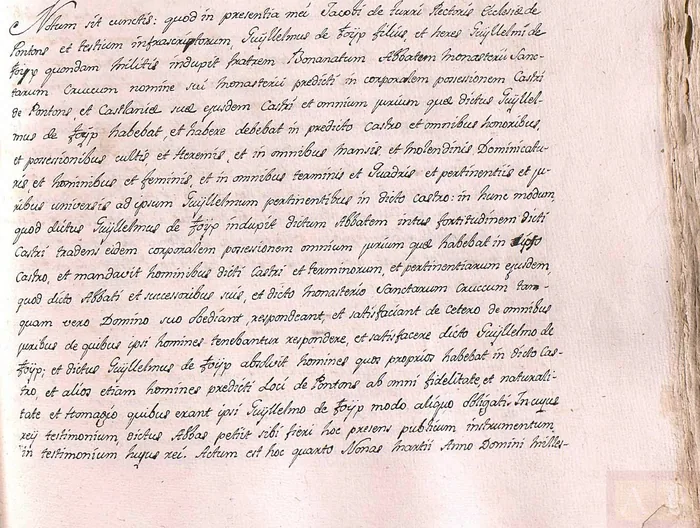
The witnesses are seventeen residents of Pontons, a list of witnesses from the neighbouring area, not to be mistaken for a full population census: Bernat Moltó, Ferrer Ponç, Pere Gener, Jaume de Bages, Ramon Burguet, Berenguer Bartomeu Escolà, Ramon de Canals, Martí de Corrius, Guerau Hortolà, Guillem Gener, Bernat Francesc, P. Soler, Bernat Gener, Vedià Pujol, Berenguer de Riudecols, Berenguer Traver and Ramon de Ravell.
The payment is made in instalments and can be traced day by day. On 22 July 1294 they collect 350 sous; on 24 July, eight thousand in Barcelona; on 29 October, 4,203 and a half sous, part in cash and part in grain; and in 1295, the remaining 796 and a half sous. The four amounts add up to 13,350 sous, not 13,000. The last three alone already add up to the agreed price. The receipts need to be checked to clarify whether the 350-sou receipt refers to something else, overlaps with a payment, or has been misread.
What do the receipts add up to?
- 22 July 1294
- 350 sous
- 24 July 1294
- 8,000 sous
- 29 October 1294
- 4,203.5 sous
- 1295
- 796.5 sous
There remain 350 sous to be clarified. The last three amounts already add up to 13,000 sous.
Between the two July receipts there is an oath that helps explain how the papers came to the monastery's archive.
On 23 July 1294, between the 350-sou receipt and the eight-thousand one, Guillem de Foix appears before the lieutenant of the veguer of Vilafranca and swears he has no other document concerning the castle of Pontons, apart from those he has already handed over to the abbot, and promises that if he finds any more he will hand them over at once. His brother Pons swears the same on the same day.
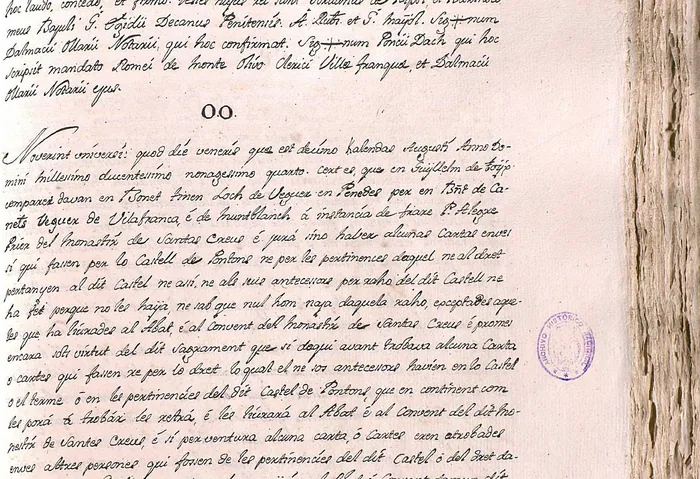
The oath documents the handover of the castle's papers to the monastery. Its closeness to the receipts suggests a link to the transfer, but it is not enough to establish the exact terms of the payment. It explains why this documentation is kept in the Santes Creus collection; its later entry into the AHN is another chapter in the archive's history.
The transfer also affects the sister's rights. In that same year, 1294, Arsenda de Foix, daughter of the late Guillem and of Lady Blanca, renounces all the right she was entitled to by inheritance and by legitimate share in the castle of Pontons and to her part of the thirteen thousand sous.
August 1381
The twelve boundary stonesTwelve boundary stones to mark the line
Almost a century later, the abbot of Santes Creus and the Cervelló family, lords of the castle of Foix, were at odds over where the line ran. A ruling of 5 July 1381 put an end to the dispute. The book copies the deed of what was done afterwards, which has not been found published.
Between 8 and 10 August twelve new boundary stones, of stone and mortar, were placed next to old markers, some with a carved cross. They ran from the pla de Sant Salvador to the riera de Repac.
Almost a century later, the abbot of Santes Creus and the Cervelló family, who now hold the castle of Foix, are at odds over where the line runs. The dispute ends with a ruling by the Infante Joan, given at the royal palace of Barcelona on Friday 5 July 1381. This part had indeed been published.
The research adds what happened afterwards, through a deed for which no edition has been found: the notarial deed of execution, which the Llibre Blanch copies in full and which is on pages 42 to 59 of the volume. It contains the agreement, the ruling in Catalan, the protest of the Cervelló family's proctors and, above all, the placing on the ground of the twelve boundary stones, one by one, with the day, the place references and, in several cases, the names of the landholders.
The ruling describes the line by the old markers, which were already there:
up to the boundary markers, which are set and placed across, towards Coll de Sant Ermengol, which markers face each other in a straight line, and look very old, and on one of them there is a carving made in the shape of a cross
The old markers were made of three stones: the marker in the middle and two "filloles" at the sides. The new boundary stone, of stone and mortar, is placed a hand-span or a foot from the old marker, depending on the passage, on the Pontons side, with the old marker left on the Foix side. They are made between Thursday 8 and Saturday 10 August 1381.
How the line was marked out
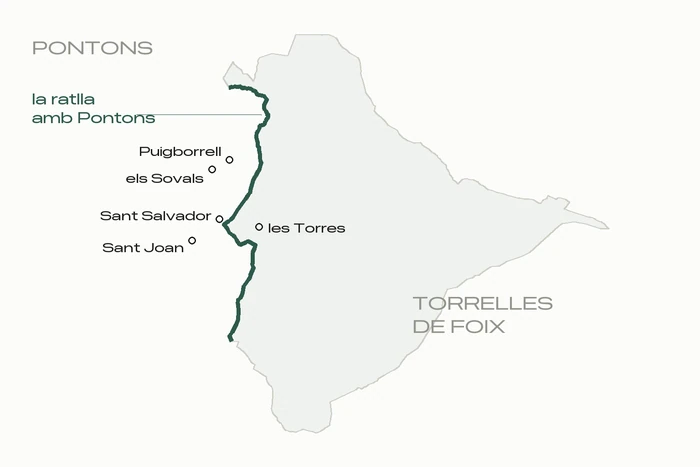
Several names in the ruling have possible matches in present-day place names. The pla de Sant Salvador can be linked to the area of Sant Salvador de la Balma and the Roques de Sant Salvador. Puigborrell survives in Can Ponç de Puigborrell. And the mas de n'Ansovall, mentioned in the dispute, can be linked to a dozen place names with the shortened form: els Sovals, el Clot dels Sovals, la Plana dels Sovals, el Torrent dels Sovals, la Font de Soval de Dalt and la de Baix, and a Creu de Soval. What we have not been able to find is the mas d'en Mascaró.
Following the order of the deed, the route runs from the pla de Sant Salvador, with a rock bearing a carved cross facing the riera de Sant Martí and the church of Sant Joan de Pontons, past the font del Calder, the coll de Sant Ermengol (where the path from the castle of Foix to that of Pontons used to run) and the coma d'Infern, as far as the Roca Llonga and the riera de Repac, where the twelfth and last boundary stone is made on a rock beside the water.
The deed lists twelve new boundary stones. It also describes intermediate old markers next to which none were built. These additional markers should not be subtracted from the twelve boundary stones listed.
In the deed, les Torres appears three times and in three different ways: the camí de les Torres Sobiranes at the fourth boundary stone, Arnau Mascaró "de les Torres de Foix" at the seventh, and "versus terminum de ses torres de Fuxio" at the eleventh, a reference to the area of les Torres that must be interpreted in its jurisdictional context.
And one line that is worth a whole chapter. When the commissioner wants to notify the lord of Foix, he sends no one to the castle:
misit Petrum Munjonis Virgarium Audientiae dicti Domini Ducis [...] ad locum de Turrillis ubi dictus Nobilis Guillelmonetus de Cervilione tenebat suum Domicilium
In August 1381 the document places Guillemó de Cervelló's residence at the place of Torrelles. The record confirms a residence, but it does not date the definitive move from the castle nor identify the building where he lived.
Also present when the first boundary marker was set were Guillem Miquel, Pere Solà and Pere Martorell; at least the last is called "de Fuxio".
now
Where the papers are, and what remainsWhat is left to search for
The volume is digitised in full and can be freely consulted online, at PARES. For this study, the selected passages have been read, but there is still work to do: going to the original parchments and transcribing documents, such as fifty-four pages on the mills of Pontons.
And there is an index entry that the book never got around to copying: a document from the Intendant of Catalonia for extracting lead from the Pontons mine.
The volume is fully digitised and freely available at PARES, and the index has been transcribed entry by entry into the association's archive. The passages selected for this study have been read; documents remain to be transcribed and readings to be reviewed.
What remains to be done is going to the originals. The parchments from cabinet 33, sack 1, should be at the AHN, Clero section, Santes Creus collection. Especially the 1381 boundary-marking record, which the copyist describes as written "in duobus Pergamenis cum quadam membrana pergamenea sutis, et junctis", the first of eighty-eight lines.
The volume still contains fifty-four consecutive pages of mill records from the municipal area of Pontons, upstream of the mills on the stream, which the index dispatches in a single line and which have been sampled but not transcribed. They begin with a 12th-century donation of a farmhouse "in ipsa Riera" from the castle of Pontons, with its mills and its watercourse.
And there is an index entry that the book never got around to copying, with the page column left blank, that is worth tracking down:
A Writ of the Lord Intendant of Catalonia to extract Varnish, and Lead, from the Pontons Mine
The word varnish was used to refer to galena, used in pottery glazing. The entry announces a writ to extract ore and documents that the monastery kept a reference to it. Without the text of the writ, we cannot pin down the date, the conditions or the specific mine.
The other seven volumes of the Llibre Blanch (L.840 to L.846) have not been examined. The one for Ancosa i Valldosera is a research lead worth pursuing, given the geographical proximity and heritage links.
What we still do not know
Research in this book continues. Questions remain, such as these:
- What the original parchments say, which should be at the Archivo Histórico Nacional. They could clarify doubtful readings, such as the receipts for payment of the castle, which add up to 350 sous more than the price.
- When the document for extracting lead from the Pontons mine dates from, and which mine it refers to. The book did not copy the text.
- What is in the other seven volumes of the Llibre Blanch, which have not yet been examined.
Documentary sources and bibliography
- Archivo Histórico Nacional, CÓDICES, L.839. "Lo Llibre Blanch" from the monastery of Santes Creus, volume I: Pontons. 18th-century copy of documents from 1080 to 1543. Fully digitised at PARES.
- Josep M. Casas Homs, "Qüestió de límits entre l'abat de Santes Creus i el senyor de Foix", Santes Creus, butlletí de l'Arxiu Bibliogràfic de Santes Creus, no. 28, vol. III, 1968, pages 431-439.
- Eufemià Fort i Cogul, El senyoriu de Santes Creus, Fundació Salvador Vives Casajuana, 1972.
This is the essential reading. The full study has 24 citations, 3 references and the documents to check it all.
Research by Amics de Foix, historical archive of Torrelles de Foix. The references make it possible to check the sources and follow the interpretations. Let us know of any correction or documentary contribution.